
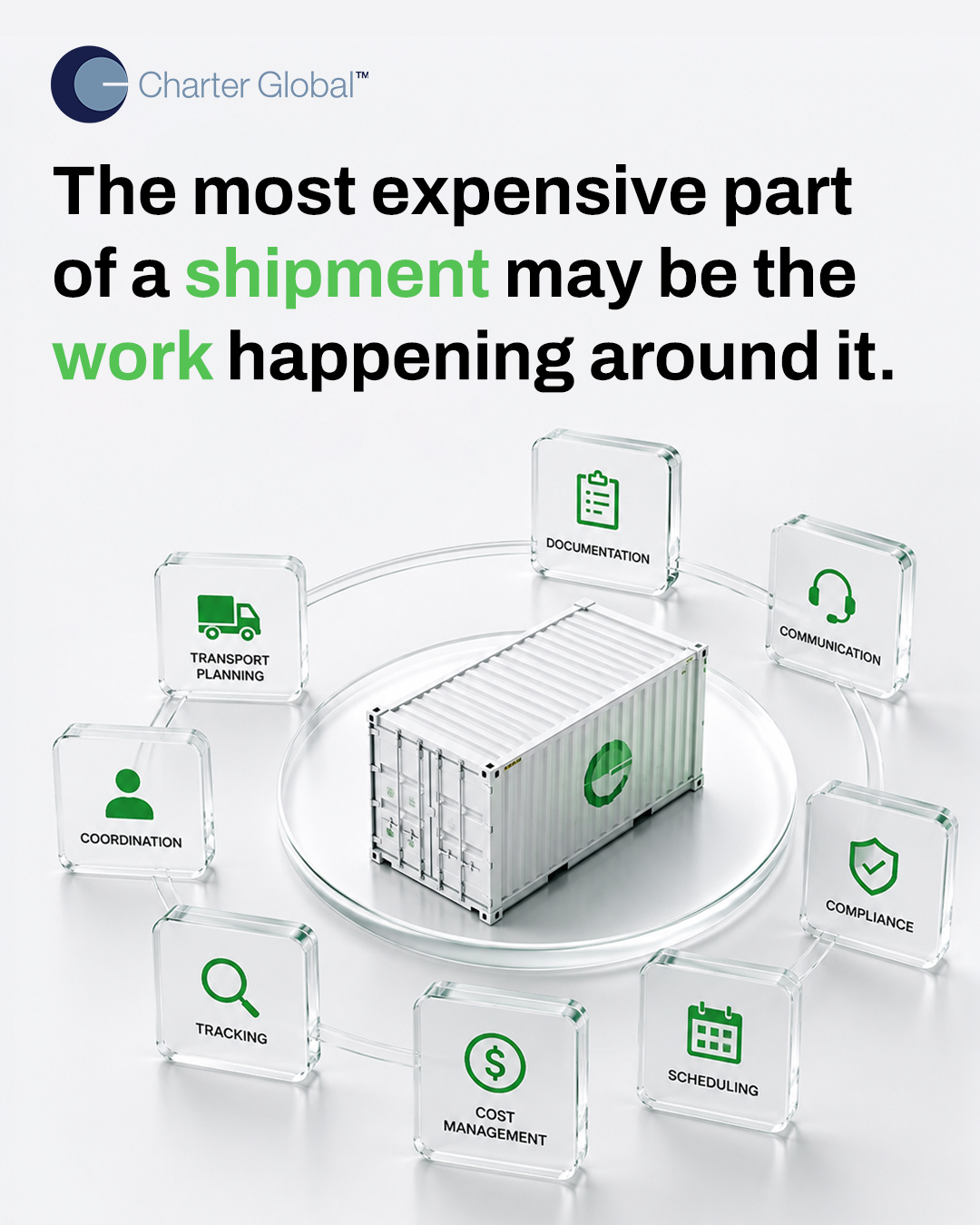
A shipment moves through five distinct stages before it’s fully closed out: booking, dispatch, transit, delivery, and invoicing.
At every single one of those stages, something manual is quietly slowing the whole operation down, and most logistics leaders can point to the symptom without connecting it back to a root cause.
A dispatcher buried in load matching every morning. A customer service rep fielding the same “where’s my shipment” call for the third time in a day. A finance team catching a billing error a full quarter after it happened.
AI automation for logistics companies isn’t a single tool that fixes all five stages at once. It’s a set of decisions about which of those friction points is costing your operation the most right now, and which one is worth solving first.
For logistics and transportation companies evaluating where to begin, the useful lens isn’t “should we automate.” It’s tracing one shipment from the moment it’s booked to the moment it’s invoiced, and being honest about where that shipment genuinely loses time along the way. Our Agentic Process Automation practice was built around exactly that kind of stage-by-stage diagnosis, rather than a one-size-fits-all automation rollout that assumes every operation’s bottleneck looks the same.
AI automation for logistics companies only earns its cost when it’s aimed at a specific, well-understood bottleneck, not deployed as a general upgrade across an operation that hasn’t diagnosed where it’s genuinely losing time.
Each stage of a shipment’s life, booking, dispatch, transit, delivery, invoicing, tends to be owned by a different team, running on a different system, with its own manual workarounds built up over years. None of those workarounds look like a crisis in isolation. A dispatcher spending an extra hour matching loads doesn’t feel like an emergency. A customer service rep checking three systems to answer one tracking question doesn’t either. But added together across a full operation, every day, those small manual steps become the single largest hidden cost most logistics companies never formally measure.
A logistics company that tries to automate all five stages simultaneously, without first identifying which one is the real drag, tends to spread its budget and attention too thin to prove real results anywhere.
A useful diagnostic exercise is tracking a handful of shipments end to end and timing exactly where a person had to intervene manually, at booking, at a mid-route change, at a documentation mismatch, at invoice reconciliation. Most operations have never done this measurement formally, which is exactly why the “automate everything” instinct takes hold: without a clear picture of where time is genuinely lost, every stage looks equally worth automating, when in practice one or two stages are usually responsible for the majority of the friction. The companies that get the clearest wins from automation are the ones that pick the single highest-friction stage first, prove it works, and use that proof to justify expanding further, rather than trying to sell a five-stage transformation before a single result exists to point to.
Before a shipment ever moves, it has to be matched to available capacity, and this is where a huge share of a dispatcher’s day quietly disappears.
Matching a load to a truck means weighing driver hours-of-service limits, carrier reliability history, fuel costs, and delivery windows all at once. Done manually, this is essentially a constraint-satisfaction problem solved load by load, with no memory of how a similar situation was resolved the last time it came up. A dispatcher handling forty loads a day runs that same mental calculation forty separate times, and the quality of each decision depends heavily on how tired or rushed they are by the time they reach load thirty-five.
AI-driven matching evaluates those same constraints simultaneously and surfaces the best available option in seconds, flagging genuine exceptions, a load with no viable carrier inside its delivery window, before it becomes a missed pickup instead of after. This doesn’t remove judgment from the process. It removes the manual arithmetic that used to consume the time judgment genuinely needs, freeing a dispatcher to spend attention on the handful of loads each day that require a human call rather than treating all forty as equally deserving of that attention.
A dispatcher spending three hours matching routine loads isn’t doing three hours of high-value work, even though the day feels equally full either way. The value in dispatch comes from the judgment calls, an unusual delivery constraint, a carrier relationship worth managing carefully, not from the repetitive matching that consumes most of the clock. Separating those two categories of work is often the single clearest way to see where automation pays for itself fastest.
A load matched poorly at booking, an unreliable carrier, a driver already close to their hours limit, doesn’t just create risk for that one shipment. It often creates a downstream problem at delivery or invoicing that gets misdiagnosed as a completely separate issue, when the real cause traces back to a rushed decision made hours earlier and several systems away.
Once a load is booked, routing decisions rarely stay static, and this is one of the clearest places where AI logistics tools show measurable value.
Traffic conditions shift, a delivery window changes, a driver runs into an unplanned delay, and a route planned at 7 AM often needs adjusting by 10. Manually re-planning routes in response to every change doesn’t scale well across a fleet running dozens of routes simultaneously, since it depends entirely on someone noticing the change and having time to react to it. AI-driven routing systems continuously reassess the full route against live conditions instead of waiting for a person to notice something has gone off plan.
A single delay early in a route tends to compound across every stop that follows it. By the time a dispatcher notices a driver is running behind and manually adjusts the remaining stops, the ripple effect has often already reached a customer who was promised a delivery window that’s no longer realistic. Routing decisions made reactively, after a delay has already occurred, are far less valuable than ones made continuously as conditions shift, simply because the cost of absorbing a delay grows the longer it goes unaddressed.
Real-time visibility into a shipment’s status depends on data flowing consistently from multiple carriers, tracking systems, and internal platforms that were never built to reconcile with each other cleanly, which is exactly the gap AI in transportation and logistics is now closing.
“Where’s my shipment” remains one of the most common customer service questions in the industry, despite how much tracking technology already exists on paper. The technology to track a shipment isn’t the missing piece. The system to reconcile that tracking data into one coherent answer usually is. A carrier’s own tracking portal, an internal TMS, and a customer-facing dashboard often each show a slightly different status, and reconciling those three views manually is exactly the kind of task that doesn’t scale as shipment volume grows.
Visibility gaps don’t just create customer frustration, they create internal friction too. A customer service team without a reliable answer often escalates to dispatch or operations, pulling those teams away from the work they’re supposed to be focused on to manually chase down a status update that a connected system should have surfaced automatically in the first place.
Bills of lading, proof of delivery, and customs paperwork arrive from dozens of carriers in dozens of slightly different formats, and this is precisely where AI in logistics and transportation historically underdelivered on its early promises.
A rule-based system built around one expected document layout breaks the moment it encounters anything else, which means a script waiting for input that matches its exact assumptions isn’t meaningfully different from manual data entry once real-world variation enters the picture. AI-driven document processing reads a scanned bill of lading regardless of layout, extracts the relevant shipment details, and cross-references them against the original order automatically, catching a discrepancy the same day instead of weeks later during a billing dispute.
The cost of getting this stage wrong compounds specifically because documentation disputes rarely stay contained to one shipment. A carrier who’s had a payment delayed over a documentation disagreement often becomes a carrier who deprioritizes your loads the next time capacity is tight, turning what looked like a paperwork inconvenience into a real capacity and relationship problem months down the line.
Invoicing sits at the end of the shipment lifecycle, which is exactly why it’s so often the last thing carriers and 3PLs get around to automating, even though it’s one of the most repetitive, error-prone parts of the entire operation.
Matching invoices against contracted rates, accessorial charges, and fuel surcharges requires the same attention to detail as any other stage, but because it happens after a shipment is already considered complete, it rarely gets the same operational urgency as booking or dispatch. That lower urgency is exactly why errors here tend to accumulate quietly rather than get caught in the moment.
A missed discrepancy doesn’t just cost money on one invoice. It quietly erodes margin on every shipment it touches, invisibly, until someone finally audits a quarter’s worth of invoices and finds the same pattern repeating across dozens of shipments that nobody flagged individually. AI applied to this stage matches invoices against contracted terms automatically, surfacing genuine exceptions, a rate that doesn’t match the agreement, a surcharge that wasn’t pre-approved, rather than requiring a finance team to manually reconcile every line item by hand.
Because invoicing errors compound silently across every shipment they touch, fixing this stage tends to produce a clear, immediately measurable dollar figure, recovered margin, faster payment cycles, fewer disputed charges, in a way that’s easier to point to than efficiency gains earlier in the shipment lifecycle. That makes it a strong candidate for a first automation project specifically because the business case writes itself once the pattern of missed discrepancies is finally visible in one place instead of scattered across a quarter’s worth of individual invoices.
Automating each of these five stages individually, with five different disconnected tools, tends to recreate the same fragmentation problem it was meant to solve, just in software form instead of manual process form.
Five separate point solutions that don’t talk to each other require yet another integration project to connect, which is often a worse position than the manual process an operation started with. The more durable approach is a single governed system that owns visibility and decision logic across the entire shipment lifecycle, from booking through invoicing.
“The mistake we see most often in logistics automation isn’t choosing the wrong tool for one stage,” says Dr. Abhinav Somaraju, Chief AI Officer at Charter Global. “It’s automating each stage in isolation, so you end up with five systems that each solve their own piece but create a new integration problem connecting them.”
Charter Global’s approach to AI automation for logistics companies is built on that governed, connected model, using the same structured, review-driven development principles behind the BMAD method to ensure every automated decision across the shipment lifecycle ties back to a rule an operations team can inspect and adjust.
Research compiled by Gitnux, citing Accenture, found that AI-driven route planning delivers a 12% decrease in freight expenses, with a 300% ROI in the first year for logistics firms that adopt it. The operations pulling ahead right now are typically the ones treating automation as one connected system across the shipment lifecycle rather than five disconnected point tools bolted together after the fact.
The right starting point for AI automation for logistics companies depends on where your operation genuinely loses the most time, not on which stage sounds the most impressive to automate first.
A freight brokerage juggling high load volume with a lean dispatch team typically feels booking and routing friction hardest, since that’s where hours get lost every morning regardless of how smoothly the rest of the operation runs.
A 3PL managing relationships across dozens of carriers with varied documentation practices usually feels delivery and documentation friction most acutely, especially once billing disputes have become a recurring cost of doing business rather than an occasional exception.
A fleet operator running tight margins on long-haul routes tends to feel invoicing and reconciliation friction hardest, since small discrepancies compound quietly across thousands of shipments before anyone notices the pattern well enough to act on it.
AI automation for logistics companies isn’t about solving all five stages at once. It’s about being honest about which one is costing your operation the most right now, proving governed automation works there, and expanding from that foundation once the first stage has earned the case for the next one.
Whichever stage turns out to be the right starting point, the diagnostic exercise itself, tracking real shipments and timing exactly where a person had to step in, tends to be more valuable than any single automation deployed on top of it. Operations that skip that step and automate based on instinct alone often end up solving a problem that was never their biggest one, while the bottleneck keeps quietly costing them time every single day.
AI automation for logistics companies refers to AI-driven systems that handle judgment-heavy, document-intensive work across the shipment lifecycle, load matching, routing, tracking, documentation, and invoicing, rather than simple rule-based scripts that break when conditions vary even slightly.
It varies by operation, but the five most common friction points are load matching at booking, manual route re-planning, fragmented in-transit tracking, inconsistent freight documentation, and invoice reconciliation. Most companies lose time across several of these simultaneously without ever measuring which one costs the most.
Traditional TMS software follows fixed rules and requires structured, consistent data to function reliably. AI logistics automation reasons over unstructured input, a scanned document, a shifting route condition, and adapts its response instead of breaking when the input doesn’t match a predefined format.
The technology to track a shipment already exists in most operations. What’s missing is a system that reconciles tracking data from multiple carriers, TMS platforms, and customer dashboards into one consistent answer, which is exactly the gap ai in transportation and logistics is built to close.
No. Automating every stage simultaneously tends to spread budget and attention too thin to prove clear results anywhere. The stronger approach is identifying the single highest-friction stage, proving automation works there, and expanding from that foundation.
AI-driven document processing reads freight paperwork regardless of formatting inconsistencies across carriers, extracting relevant details and flagging discrepancies the same day instead of weeks later during a billing dispute, when resolving the issue becomes far more costly.
Invoicing happens after a shipment is already considered complete, so it carries less day-to-day operational urgency than booking or dispatch. That lower urgency lets errors accumulate quietly, which is exactly why fixing this stage tends to produce a clear, measurable financial return once addressed.
Track a handful of real shipments end to end and time exactly where a person had to intervene manually. The stage consuming the most manual intervention time, not the one that sounds most impressive to automate, is usually the right starting point.
No. It removes repetitive, high-volume tasks like manual load matching and document re-entry, freeing dispatchers and operations staff to focus on judgment calls, exceptions, and carrier relationships that genuinely require human decision-making.
A single connected system avoids the integration burden of stitching together five disconnected point tools, and it ensures every automated decision across the shipment lifecycle, from booking to invoicing, can be traced back to a rule an operations team can inspect and adjust.

Charter Global is a digital solution engineering company specializing in data, agentic AI automation, and end-to-end cloud transformation.


